

 iKörkort
 Tests
Language
Tests
Language
 Bookmarks
 Overview
 Introduction

 The car
 People
 The environment
 Driving in towns and cities
 Driving on country roads
 Darkness and slippery conditions
 Accidents
 Numbers and statistics
 The driving test
 Other
Other
 Audiobook
In urban traffic, you often share the road with pedestrians, cyclists, moped riders and other vulnerable road users. They are far less protected than you and can be seriously injured in a collision, even at low speeds.
In this chapter, you will learn how to adapt your speed, show consideration and follow the rules at pedestrian crossings, cycle passages, cycle crossings and other places where the risk of accidents is particularly high.
In built-up areas, you often encounter many unprotected road users. Pedestrians, cyclists and moped riders can quickly end up close to the car, especially at junctions, bus stops, schools and pedestrian crossings. You must therefore drive carefully and adapt your speed to the situation.
As a driver, you must always show consideration to pedestrians, cyclists and moped riders. Children, elderly people and people with disabilities must be given particular consideration, as well as the time they need, as they may have more difficulty detecting hazards, judging traffic, or moving quickly.
 In densely built-up areas, you must maintain a sufficiently low speed to reduce the risk of accidents
Your speed affects how much time you have to detect risks, think, and act. The lower your speed, the easier it is to stop in time and avoid serious accidents. This is especially important where pedestrians, cyclists, and moped riders may come close to your car.
You must always adapt your speed to the traffic situation. In other words, simply following the speed limit is not enough. You must drive in a way that allows you to stay in control of the car and stop within the part of the road you can see clearly, and before any obstacle that can be expected.
 You must adapt your speed so that you are always able to stop in time
Your speed is crucial if you hit a pedestrian or another vulnerable road user, such as a cyclist or moped rider. The higher the speed, the greater the risk of serious or fatal injury. The difference between a collision at 30 km/h and one at 50 km/h can be very large in terms of how severe the injuries become. Even a small increase in speed can therefore have very serious consequences.
 If a pedestrian is hit at 50 km/h, the risk of serious or fatal injury is very high
On some road sections and in some areas there are road signs that state a recommended lower speed. In these places, specific speed reduction measures have often been implemented – usually through the use of speed bumps or other obstacles – or conditions are such that it is appropriate to drive at a lower speed than the highest permitted speed. Such recommended reduced speeds exist mainly to protect pedestrians and other unprotected road users.

Recommended lower speed
The recommended speed is not a speed limit, but the sign indicates that you should drive at a lower speed at that location. You must always adapt your speed to the conditions.
You must always be prepared to act when driving. Furthermore, in certain risky situations – for example, when you approach children playing on or beside a road – you must ready yourself for action. This means preparing yourself, before anything happens, to brake quickly or steer away if necessary. When you ready yourself for action, you are more focused and better prepared to respond. This can shorten the reaction time.
If you think you may need to brake quickly, you should take your foot off the accelerator and keep it ready over the brake pedal. This is called brake readiness.
 By readying yourself for action and trying to anticipate risks, you can stop the car much faster if you discover an obstacle or hazard
There are many situations that require readiness for action. Some examples are when you:
You must always be aware of the fact that children may be found on or beside the road almost anywhere. In residential areas and outside schools and kindergartens, you must be especially attentive. As you approach children, you must adapt your speed and ready yourself for action.
Children are often impulsive and do not always think before they act. They may suddenly run out into the road, perhaps while chasing a ball or running away from someone during a game. Before reversing, keep in mind that children sometimes hide or play behind parked cars as well.

Always remember that children can be very impulsive and that they do not understand the dangers of traffic
Even if you think a child has seen you, the child may not understand the danger or may still run into the road. The opposite can also happen: you may not see the child. Children are small and can be hard to see behind parked cars, bushes, or other obstacles.
Children also often play together with other children. So when you see a child on or near the road, you have to be prepared for there to be more children nearby.
Keep in mind that children do not have the same vision and hearing abilities that adults do. They cannot switch from near to long-distance vision or determine where a sound is coming from in the same way adults can. Children are also unable to accurately judge speeds and distances.
Remember: If you see a child near the road, always assume that the child may do something unexpected.
 You must adapt your speed and ready yourself for action as you approach children on or beside the road

Children crossing
School transport is used to take children to and from school. When a school transport vehicle stops to pick up or drop off children, the traffic situation can quickly become hazardous, as children may suddenly cross the road.
You must always pass a stationary school transport vehicle at a low speed and with great caution. Be especially careful if the vehicle's warning lights are flashing. Always expect children to run out in front of or behind the vehicle.
About 100 metres before a school transport vehicle stops to pick up or drop off children, the driver switches on the flashing warning lights. The lights flash during the stop and are switched off about 100 metres after the stop.
 Before, during and after a school transport vehicle picks up or drops off children, warning lights on the vehicle flash
Elderly people should always be given extra consideration, especially in traffic. Elderly people often have poorer vision, hearing, balance and a diminished ability to assess traffic situations and make quick decisions. Many elderly people have problems at junctions due to the large number of vehicles and sensory impressions. Have patience and always give elderly people who walk, cycle or drive the time they need.
Some disabilities are easy to notice, while others are not visible at all. You should therefore always pay attention to people near the road and be prepared for the fact that they may find it harder to understand the traffic situation or may need more time.
 Many road users have disabilities that are hard to notice, so never assume that all people who are close to the road are able to hear your car or see it approaching
You must not sound your horn at someone just because they are crossing the road slowly. The horn may only be used to attract the attention of other road users in order to avert a dangerous situation. For example, if you suspect a pedestrian has not seen your car and is heading out onto the street.
For blind and visually impaired people it can be difficult and unpleasant to be out in traffic. Always assume that a person with a white stick or guide dog is visually impaired and should be given extra consideration as well as time.
Visually impaired people can communicate their intentions with their stick. Pay attention to how they use it:
 Extra consideration should be given to people with a white stick or guide dog
The road sign which indicates that people with impaired vision are common has a symbol consisting of five black dots in a row. The road sign which indicates that people with impaired hearing are common has a symbol consisting of three black dots in a circle.

Impaired vision

Impaired hearing
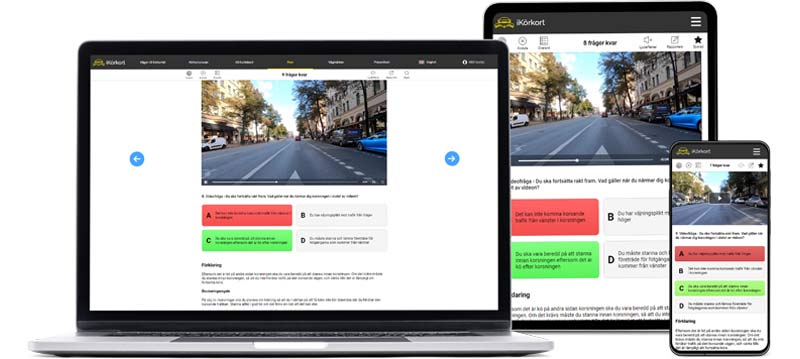
As a member, you get access to 1,400+ driver's licence theory questions with explanations and unlimited practice tests.
4.7 out of 5 based on 1,000+ reviews on Reco.
Pedestrians are among the most vulnerable road users because they have no protection in a collision. Even at relatively low speeds, being hit by a vehicle can cause very serious injuries. Around 25 pedestrians are killed in traffic each year.
Pedestrians are particularly vulnerable when crossing the road, especially at pedestrian crossings in built-up areas. Many serious and fatal accidents occur at pedestrian crossings, even though they are intended to make it safer for pedestrians to cross the road.
As a driver, you must therefore be very attentive at pedestrian crossings and adapt your speed so that you can stop if necessary. This applies whether the crossing is supervised or unsupervised, even if you have a green light, and whether you are driving straight ahead or turning.
 Pedestrian crossings are a place where pedestrians should be protected and able to feel safe
As a driver, you must give way to pedestrians who have entered or are about to enter an unsupervised pedestrian crossing, which is a pedestrian crossing that is not equipped with traffic signals.
At supervised pedestrian crossings, the duty to give way is controlled by traffic signals. You may only continue when the traffic light is green. If you are turning and both you and the pedestrians have a green signal, you must give way.
Even when you have a green light and are driving straight ahead, you must be prepared to stop. There may be pedestrians who started crossing on a green signal but have not had time to reach the other side. Let them cross safely before you continue.
 At supervised pedestrian crossings the duty to give way is regulated by traffic signals
If you are unsure whether a pedestrian intends to cross at a pedestrian crossing, you must slow down or stop until you are completely sure what they intend to do. You may try to make eye contact, but do not drive on until you are sure the pedestrian is not going to step onto the crossing.
You should not signal to a pedestrian or cyclist to cross at a pedestrian crossing. They may interpret your gesture as meaning that it is safe to cross the road, even though vehicles may be approaching from other directions.
 Try to make eye contact with hesitant pedestrians to reduce the risk of misunderstandings
Residential areas and pedestrian zones are places, usually streets or squares, where pedestrians have priority. As a driver, you must drive at walking speed and adapt completely to pedestrians.
Within areas following either of the road signs Residential area or Pedestrian zone, the following rules always apply:
 In residential areas and pedestrian zones all vehicle traffic must be adapted to pedestrians
It is normally not allowed to drive along streets in pedestrian zones. However, drivers are allowed to cross them if they follow the rules for residential areas.
Driving along streets in pedestrian zones is only allowed for:

Residential area

Pedestrian zone
Cyclists are becoming more and more common, and cycle paths and cycle lanes are continually being expanded in our towns and cities. Electric scooters are also now a common feature of the traffic environment. This means that you are more likely to encounter vulnerable road users close to your vehicle, especially at junctions, crossings, exits and in heavy traffic.
These road users are often more exposed than car drivers because they do not have the protection of a car. When passing them you must adapt your speed and keep enough clearance to your sides. Be prepared for two-wheeled road users to wobble, especially in strong winds, on uneven road surfaces or when they need to turn. Older cyclists may also find it harder to look behind them and check the traffic before turning.
Keep in mind that cyclists and moped riders are allowed to overtake you on both the left and right side. This means that a cyclist or moped rider may suddenly appear next to you, or just behind you. The risks associated with this are greatest when you turn in densely built-up areas with a lot of traffic.
 Cyclists and moped riders are allowed to overtake you on both the left and right side
If you are about to turn and a cyclist or moped rider is beside you, or approaching quickly on the side you are turning towards, you must not turn across their path. Instead, slow down, check the traffic in your rear-view mirror, side mirrors and blind spot, and wait to turn until you are sure it can be done safely.
Electric scooters can be difficult to spot in time because they are small, quiet and often move quickly in urban traffic. Many electric scooters are classified as bicycles, which means that the person riding them must generally follow the same traffic rules as cyclists.
Be especially alert for electric scooters when turning, moving the car sideways or crossing cycle paths and cycle lanes, as they can approach quickly and be easy to miss.
Mopeds may be ridden on different parts of the road depending on their class. You should therefore be prepared to encounter moped riders on the carriageway, on the road shoulder and near cycle paths. Be especially alert at junctions and exits, and when turning or moving the car sideways.
Class 1 mopeds (EU mopeds) should primarily be driven on hard shoulders and secondly on carriageways. Class 1 mopeds must not be driven in public transport lanes (bus lanes), in cycle lanes, on cycle paths or on motorways or clearways.
Class 2 mopeds are generally ridden in the same places as bicycles. They should normally be ridden on a cycle path if one is available, otherwise on the hard shoulder or on the carriageway where permitted.
 Class 1 mopeds should primarily be driven on hard shoulders and secondly on carriageways
To improve traffic flow and reduce the risk of accidents for cyclists and riders of class 2 mopeds, many roads have special lanes, paths and crossings intended for these road users.
It is important to be able to tell these different road features apart, especially cycle passages and cycle crossings, as different rules apply. You therefore need to recognise what type of road feature you are approaching and adapt your driving accordingly.
Keep in mind that cyclists and riders of class 2 mopeds may use the carriageway even if there is a cycle path beside the road. You should therefore be prepared for this and adapt your driving accordingly.

Cycle crossing

Cycle street
When approaching a place where cyclists or moped riders may cross your path, you must adjust your speed and be prepared to stop. Your obligations depend on the type of crossing you are approaching, whether it is supervised or unsupervised, and whether you are driving straight ahead or turning across it.
Cycle lanes
You may only cross a cycle lane if you can do so without endangering or unnecessarily obstructing cyclists and moped riders in the lane.
Cycle paths
When you are going to cross a cycle path you have a duty to give way.
Unsupervised cycle passages
When you approach an unsupervised cycle passage on a straight road, cyclists and moped riders normally have a duty to give way. You must still adapt your speed so that you do not endanger anyone who are on or are about to enter the passage.
When you are about to cross an unsupervised cycle passage after making a turn or emerging from a roundabout, you should drive at a low speed and stop for cyclists and moped riders who are on or are about to enter the passage.
 As the truck driver is going to cross the cycle passage in connection with a turn, he must stop for cyclists who are on or about to enter the cycle passage
Supervised cycle passages
When you approach a supervised cycle passage on a straight road you must obey traffic signals. However, you must also allow cyclists and moped riders, who have correctly entered the cycle passage, to cross in peace and quiet. This is the case even if you have a green light.
When you are about to cross a supervised cycle passage in connection with a turn, you should drive at a low speed and give way to cyclists and moped riders who have correctly entered or are about to enter the cycle passage. This is the case even if you have a green light.
Cycle crossings
When you are about to cross a cycle crossing you have a duty to give way to cyclists and moped riders who are on or about to enter the cycle crossing.
Cycle street
When entering a cycle street you have a duty to give way to all vehicles on the cycle street.
 Always be prepared to stop when you approach an intersecting cycle path, cycle passage, cycle crossing or cycle street
Pedestrian crossings
When riding across a pedestrian crossing, a cyclist must always give way to both pedestrians and vehicles on the road. If the cyclist gets off and walks the bike across the crossing, they are instead treated as a pedestrian. In that case, you as a driver must give way.
If you approach a pedestrian crossing where a cyclist is riding across, you must still adapt your speed or stop if necessary to avoid an accident, even if it is the cyclist who is required to stop and give way.
Remember: Whenever your path crosses cycle traffic, you must always adapt your speed and be prepared to stop.
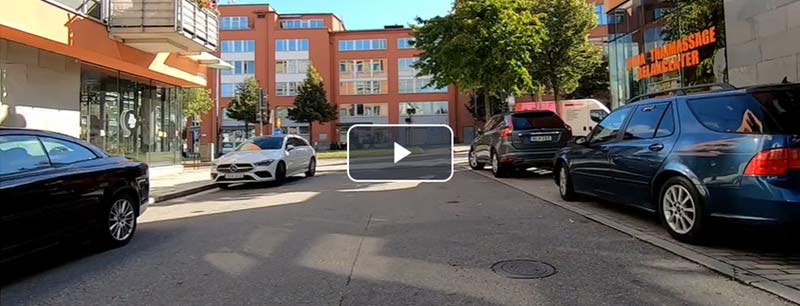
Click on the picture below to watch Transportstyrelsen's instructional video about cycle passages and cycle crossings.

When you are going to pass a junction, you must be aware of the fact that cyclists and riders of class 2 mopeds may usually turn left in two different ways:
Cyclists and moped riders in a lane that is solely intended for right-turning traffic are not allowed to make "the wider turn".
Even if it looks like a cyclist is going to continue straight ahead or turn right at a junction, he or she might turn left when you least expect it. Be extra attentive at junctions, especially when there is a lot of traffic, so that no misunderstandings arise.