

 iKörkort
 Tests
Language
Tests
Language
 Bookmarks
 Overview
 Introduction
 The car
 People
 The environment
 Driving in towns and cities
 Driving on country roads
 Darkness and slippery conditions
 Accidents
 Numbers and statistics
 The driving test
 Other
Other
 Audiobook
How you position the car has a major impact on road safety and on how well you interact with other road users. By choosing the correct lane in good time and positioning the car clearly, you show other road users what you intend to do and reduce the risk of misunderstandings.
In this chapter, you will learn how to position the car when turning, at junctions, in roundabouts and on roads with several lanes. You will also read about lane changes, public transport lanes, reversible lanes (lanes where the direction of travel can be changed) and how to turn around safely.
Where you position the car helps other road users understand your intentions. By choosing the correct lane in good time and keeping a clear position on the road, you make traffic safer, smoother and easier to predict.
When positioning your car you must also leave sufficient space between your car and pedestrians, cyclists and parked cars. The minimum margin should be at least the width of a car door, but at higher speeds or in uncertain situations, you may need to leave more space.
 Always pass cyclists, pedestrians and parked cars with a suitable safety margin
You may only turn at a junction if it can be done without endangering or obstructing others driving in the same direction as you. Pay special attention to the traffic behind you.
Before turning right at a junction you should position the car close to the right-hand side of the road. Stay close to the right-hand side of the road after completing the turn.
Before turning left at a junction you should position the car as close to the left edge of your lane as possible. This maximises your visibility and makes it easier for other drivers to see your car and to pass you on the right. Complete the turn on the right-hand side of the road.
Before turning left at a junction on a one-way street you should position the car as close to the left-hand side of the road as possible. Complete the turn on the right-hand side of the road.
When turning left at a junction you have a duty to give way to all oncoming traffic.
When turning onto a road with several lanes in the same direction, adapt your turn to the surrounding traffic and to where you intend to go. Choose the lane that best suits your continued journey, without obstructing or endangering other road users.
 You have a duty to give way to oncoming traffic when turning left at a junction
Roundabouts increase traffic safety by reducing speeds and increase accessibility by evening out the traffic flow.
When you are about to enter a roundabout you must give way to traffic already on the roundabout. Reduce your speed well in advance of the roundabout and try to find a gap in traffic to move into. Do not stop unnecessarily, as this can create queues, but do not enter until it is safe to do so.
When driving through a roundabout, plan your lane choice in good time, cooperate with road users in other lanes, and be prepared to slow down or stop for pedestrians, cyclists and moped riders at entrances and exits.

You must give way to traffic on the roundabout
You must indicate when changing lanes in a roundabout and when exiting it. However, you are not required to indicate right or left when entering, because traffic in a roundabout travels in one direction only. In some situations, it may still be appropriate to indicate before entering, as this helps other road users understand where you intend to go.
How you should position your car before you enter, and once you are on, the roundabout depends on which exit you intend to take.

How you should position your car before you enter the roundabout depends on whether you are going to turn right, drive straight on or turn left
If a roundabout has several lanes, you can initially position the car closer to the centre of your lane.
Always follow road signs, direction signs and lane arrows if they show which lane you should choose. If there are no such instructions, you can use the following basic rules:
Remember: You must give way when entering a roundabout and indicate right when leaving it.
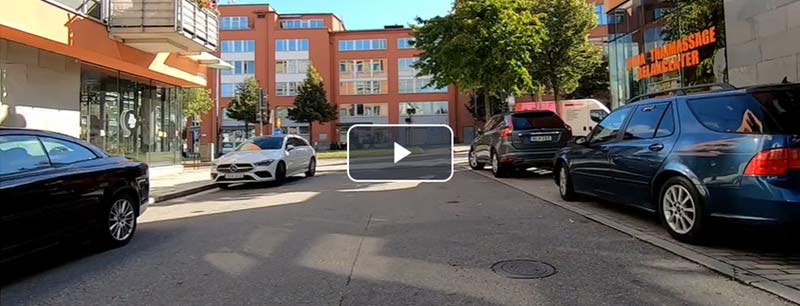
Click on the picture below to watch Transportstyrelsen's instructional video (Swedish only) about driving in a roundabout.

When driving in towns and cities, roads often have several different lanes leading to different destinations. It is important to plan your lane position in good time.
Usually you should drive in the right-hand lane. But in the following situations, you can choose the most suitable lane for your destination:
In practice, this means that in built-up areas you can often choose the lane that best suits your destination more freely than on roads with higher speed limits. The aim is to reduce unnecessary lane changes, since lane changes in heavy traffic increase the risk of accidents.

You can usually choose the most suitable lane for your destination when driving in densely built-up areas
At junctions, there are often lane assignment signs above the road and lane arrows on the roadway that you should follow. They show where different lanes lead and in which direction or directions you may drive.
If you have chosen the wrong lane, you should continue in the direction the lane leads and then turn around at a suitable place. Avoid last-minute lane changes, as they often surprise other road users and increase the risk of accidents.

Lane assignment sign
If you are driving in a lane separated by a solid lane line, you must follow the direction or directions shown by the lane arrow on the road.
Remember: Plan your lane choice in good time. Last-minute lane changes increase the risk of misunderstandings and accidents.
 At junctions, there are often lane arrows on the roadway that show in which directions you are allowed to turn
On roads that are not one-way, there are often lanes for traffic travelling in the opposite direction. You are not allowed to drive in these lanes. Solid lines, road markings and other instructions normally make it clear which lanes are intended for oncoming traffic.
As a member, you get access to 1,400+ driver's licence theory questions with explanations and unlimited practice tests.
4.7 out of 5 based on 1,000+ reviews on Reco.
You are normally not allowed to drive in public transport lanes (bus lanes). These lanes are reserved for vehicles in regular service. If the lane is on the far right in your direction of travel, cyclists and riders of class II mopeds may also use it, unless otherwise indicated.
You may, however, cross a public transport lane or another lane reserved for certain types of vehicles. For example, if you are driving in the left-hand lane on a road with three lanes, you may cross the middle lane, even if it is a public transport lane, to reach the right-hand lane.
Also pay attention to lane arrows at junctions where a public transport lane ends before the junction but continues on the other side. In that situation, the lane arrows do not always apply to vehicles coming from the public transport lane. A bus may therefore be allowed to continue straight ahead through the junction, even if the lane arrow before the junction shows that other traffic must turn right or left.

Always be prepared for buses to continue straight ahead through junctions, even if they were in a lane that, before the junction, only allowed traffic to turn right or left
Avoid driving alongside large vehicles in sharp turns and roundabouts. Large vehicles may need extra space and may move into your lane to complete the turn. If you drive beside a large vehicle as it is turning your car might be damaged. Instead, lower your speed and allow the large vehicle to drive into the turn or roundabout ahead of you.
Reversible lanes are uncommon, but they can be used on roads where traffic flow varies greatly during the day. A reversible lane is a lane where the direction of travel can be changed, usually to give more space to the direction where traffic is heaviest.
The direction in which you may drive is normally shown by lane control signals above the lane. The signals can change depending on the time of day and the traffic flow. A green arrow means that the lane is open to traffic in your direction, while a red cross means that you must not drive in that lane. In some cases, barriers are also used to close the lane.
 On roads with reversible lanes, the direction of travel can change depending on traffic flow and the time of day
Before changing lanes in heavy traffic, you should first ask yourself whether the lane change is really necessary. Unnecessary lane changes increase the risk of accidents and often irritate other road users. You are not allowed to weave back and forth between lanes just to gain a few places in the queue.
When changing lanes, both the driver changing lanes and the drivers in the adjacent lane have a responsibility.
The driver changing lanes has the main responsibility for ensuring that the lane change can be made without danger or unnecessary obstruction to other road users. At the same time, drivers in the adjacent lane must show consideration and adapt their speed if necessary to make the lane change easier.

Lane changes in heavy traffic increase the risk of accidents and should preferably be avoided
The most suitable place to change lanes is well in advance of or immediately after junctions. Just before junctions, solid lines usually prohibit lane changes.
If you need to change lanes, do so calmly, clearly and without surprising other road users.
* The blind spot is the area to the side and diagonally behind the car that you cannot see in the mirrors. You check the blind spot by briefly glancing over your shoulder (in the direction you are moving the car).
Remember: The driver changing lanes has the main responsibility for ensuring that the lane change is made safely.
If another driver signals to change into your lane, you should help by reducing your speed and creating a larger gap between you and the vehicle in front.
When two lanes merge into one, road users often need to use the zipper merge, also called merging in turn. This means that vehicles take turns to move ahead – one from one lane, then one from the other, and so on. For this to work, road users need to cooperate and show mutual consideration.
Where lanes merge, the road sign Merge may be posted.

Merge
You may only turn around or reverse if it can be done without endangering or obstructing other road users.
If you need to turn around in city traffic, there are three common options:
Of the three options, driving around the block is the safest option. It minimises the risk of you surprising or being surprised by other road users.